What Is Laparoscopic Surgery?
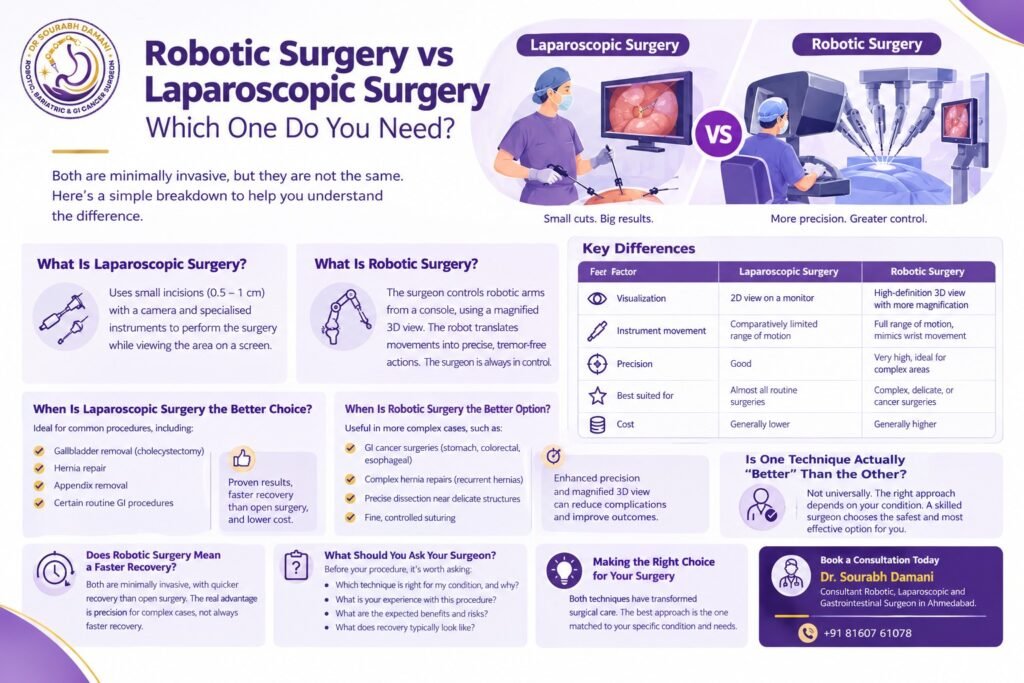
If your doctor has recommended surgery for a gastrointestinal, hernia, or cancer-related condition, you may have come across two modern options: robotic surgery and laparoscopic surgery. Both are minimally invasive, but they are not the same. Here’s a simple breakdown to help you understand the difference.
What Is Laparoscopic Surgery?
Laparoscopic surgery, often called “keyhole surgery,” is performed using small incisions, typically 0.5 to 1 cm in size. The surgeon inserts a thin tube with a camera (laparoscope) and long, specialised instruments through these incisions to perform the operation while viewing the surgical area on a screen.
What Is Robotic Surgery?
Robotic surgery is an advanced form of minimally invasive surgery where the surgeon controls robotic arms from a console, using a magnified 3D view of the surgical area. The robotic system translates the surgeon’s hand movements into precise, tremor-free actions inside the body. Importantly, the robot does not operate on its own — the surgeon is in complete control at all times.
What Are the Key Differences Between the Two?
|
Factor
|
Laparoscopic Surgery
|
Robotic Surgery
|
|---|---|---|
|
Visualization
|
2D view on a monitor
|
High-definition 3D view with more magnification
|
|
Instrument movement
|
Comparatively limited range of motion
|
Full range of motion, mimics wrist movement
|
|
Precision
|
Good
|
Very high, ideal for complex areas
|
|
Best suited for
|
Almost all routine surgeries
|
Complex, delicate, or cancer surgeries
|
|
Cost
|
Generally lower
|
Generally Higher
|
When Is Laparoscopic Surgery the Better Choice?
Laparoscopy remains an excellent option for many common procedures, including:
- Gallbladder removal (cholecystectomy)
- Straightforward hernia repair
- Appendix removal
- Certain routine gastrointestinal procedures
For these cases, laparoscopic surgery offers proven results, faster recovery than open surgery, and lower cost, without needing the added precision of robotics.
When Is Robotic Surgery the Better Option?
Robotic surgery tends to offer a real advantage in more complex cases, such as:
- Gastrointestinal cancer surgeries (stomach, colorectal, esophageal)
- Complex hernia repairs, including recurrent hernias
- Procedures requiring precise dissection near delicate structures, nerves, or blood vessels
- Cases requiring fine, controlled suturing
In these situations, the enhanced precision and better magnified 3D visualization can help reduce complications and improve surgical outcomes.
Does Robotic Surgery Mean a Faster Recovery?
Both robotic and laparoscopic surgery are minimally invasive, meaning smaller cuts, less pain, and quicker recovery compared to open surgery. However, robotic surgery does not always mean a dramatically faster recovery than laparoscopy for simple procedures — the real advantage lies in the precision it offers for complex cases, not necessarily recovery time.
Is One Technique Actually "Better" Than the Other?
Not universally. The right technique depends entirely on your specific condition. A skilled surgeon will choose the approach that offers the safest and most effective outcome for you, rather than defaulting to the most advanced technology available. In many cases, laparoscopic surgery is still the ideal choice, while in others, robotic precision makes a meaningful difference.
What Should You Ask Your Surgeon Before Deciding?
Before your procedure, it’s worth asking:
- Which technique is recommended for my specific condition, and why?
- What is your experience with this particular procedure?
- What are the expected benefits and risks of each approach in my case?
- What does recovery typically look like?
Making the Right Choice for Your Surgery
Both robotic and laparoscopic surgery have transformed modern surgical care, offering safer, less painful alternatives to traditional open surgery. The best approach is the one matched to your specific condition and needs.
Dr. Sourabh Damani is a consultant robotic, laparoscopic, and gastrointestinal surgeon in Ahmedabad, with extensive experience in both techniques across bariatric, hernia, and GI cancer surgery. Book a consultation today to discuss which approach is right for your treatment.