Stomach Surgery in Ahmedabad
Laparoscopic and open surgical treatment for stomach cancer, complex peptic ulcers, gastric outlet obstruction, and gastrointestinal stromal tumours (GIST), planned according to precise staging, diagnostic imaging, and biopsy result
The stomach can develop conditions that restrict the passage of food, compromise its structural lining, or involve abnormal tissue growth. Because each pathology affects a different layer or section of the stomach, the surgical approach is tailored directly to the specific disease and its extent.
Stomach Surgery Covers More Than One Problem
Gastric Cancer (Stomach Cancer)
Malignancies that typically begin in the inner mucosal lining of the stomach and can penetrate deeper into the muscular wall over time. It requires precise staging via endoscopy, CT scans, or PET-CT imaging to coordinate surgery alongside medical oncology.
Gastrointestinal Stromal Tumours (GIST)
Submucosal tumours that grow from the specialized pacemaker cells in the stomach wall. Unlike typical carcinomas, these are often localized and managed by removing the tumor with a clear margin of healthy tissue, frequently using laparoscopic techniques.
Gastric Outlet Obstruction
A mechanical blockage at the lower end of the stomach (antrum or pylorus) caused by chronic ulcer scarring or advanced tumours. It prevents food from entering the small intestine, leading to persistent vomiting and weight loss, and requires surgical bypassing or clearing.
Complex Peptic Ulcer Disease
While most ulcers heal with medication, cases that present with severe bleeding, structural narrowing, or acute perforation (a tear in the stomach wall) require emergency or elective surgical intervention to repair the defect.
Stomach Surgery in Ahmedabad: Procedures We Perform
The specific operation is determined entirely by the location of the disease, its stage, and the patient’s general health. These are the primary procedures performed for stomach conditions, categorized by their surgical objectives.
Subtotal / Partial Gastrectomy
for Lower Stomach Lesions
The lower part of the stomach (the antrum and pylorus) is surgically removed. The remaining healthy upper stomach is then reconnected directly to the small intestine (jejunum) to re-establish the digestive tract.
When performed for cancer, this includes a detailed lymphadenectomy to remove surrounding lymph nodes that might contain migrating cancer cells. It is performed through either a laparoscopic or open approach, depending on the lesion size and patient fitness.
Duration: 1.5 - 2.5 hours
Recovery: 1 - 2 weeks
Total Gastrectomy
for Upper or Extensive Tumours
The entire stomach is surgically removed from the lower esophagus down to the beginning of the small intestine. To reconstruct the digestive tract, a loop of the small intestine (jejunum) is brought up and connected directly to the esophagus (Roux-en-Y esophagojejunostomy), allowing food to bypass the stomach completely.
Duration: 3.5 - 5 hours
Recovery: 5 - 8 days (Hospital Stay)
Wedge Resection
for GIST and Non-Carcinoma Tumours
Only the specific small section of the stomach wall containing the tumour is excised, leaving the rest of the stomach intact. This is the standard choice for localized stromal tumours (GIST) that have not spread to the lymph nodes.
Because it preserves the overall shape and function of the stomach, recovery is faster, and the procedure is highly suited to a laparoscopic approach through small abdominal incisions.
Duration: 30- 60 minutes
Recovery: 1 - 2 days
Gastrojejunostomy (Bypass Surgery)
for Obstruction
A structural detour is created by connecting a loop of the small intestine directly to the upper part of the stomach, completely bypassing a blocked pylorus or antrum.
This is performed when a tumour or dense scar tissue cannot be safely removed, immediately restoring the patient’s ability to swallow fluids and soft food without vomiting.
Duration: 1.5 - 2.5 hours
Recovery: 1 - 2 weeks
Before Stomach Surgery: What to Expect
A conclusive diagnosis and precise staging form the foundation of every treatment plan. The pre-operative sequence follows an established pathway.No esophagus surgery is scheduled without a clear diagnostic picture. This is the sequence followed for every case.
1. Clinical Assessment
A thorough evaluation of symptoms, nutritional status, weight loss patterns, and prior medical history or medication use.
2. Endoscopy & Biopsy
An upper GI endoscopy to look directly at the esophageal lining, check for hernia, inflammation, strictures or suspicious tissue.
3. Staging & Imaging
High-resolution CT scans, Endoscopic Ultrasound (EUS), or PET-CT scans are utilized to determine the depth of the lesion and check if the disease involves nearby lymph nodes or distant organs.
4. Multidisciplinary Planning
For oncological cases, the surgical plan is closely coordinated with medical oncologists to decide whether chemotherapy is required before surgery (neoadjuvant) or after surgery (adjuvant).
Recovery After Stomach Surgery
Patients are monitored closely for fluid balance. If a total gastrectomy was performed, nutrition is maintained via a temporary feeding tube while the new surgical connections begin to heal. Light mobilization (walking around the room) begins early.
Patients are monitored closely for fluid balance. If a total gastrectomy was performed, nutrition is maintained via a temporary feeding tube while the new surgical connections begin to heal. Light mobilization (walking around the room) begins early.
Sips of clear liquids are introduced gradually once bowel function returns. Patients are typically discharged once they tolerate an oral liquid diet and pain is well-controlled with oral medications.
Diet shifts from liquids to pureed and soft foods, divided into 6 to 8 small meals throughout the day rather than a few large ones, allowing the remaining anatomy to adapt. Normal daily walking is encouraged, but heavy lifting remains restricted.
Regular solid foods are gradually reintroduced based on individual tolerance. Long-term nutritional tracking, including vitamin B12 supplementation, is established for patients who underwent a total gastrectomy.
Meet Dr Sourabh Damani
Stomach Surgeon
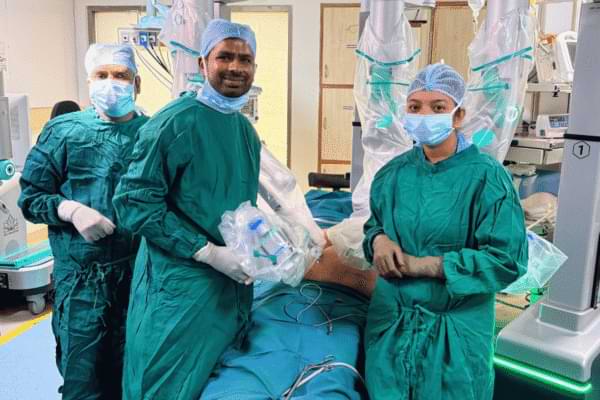
Practising as a Gastrointestinal and Laparoscopic Surgeon in Ahmedabad, with a focused interest in upper gastrointestinal conditions, gastric malignancies, and complex reconstruction of the digestive tract.

Performs laparoscopic and open subtotal gastrectomy, total gastrectomy, and wedge resections for gastric tumours.
Collaborates with medical and radiation oncologists to plan multimodal treatment protocols for stomach cancer cases.
Manages emergencies related to peptic ulcer disease, including laparoscopic repairs for stomach perforations.
Stomach Surgery in Ahmedabad: Frequently Asked Questions
Can a person live normally without a stomach?
Yes. After a total gastrectomy, the small intestine is connected directly to the esophagus. While digestion changes, the body still absorbs nutrients. Patients adapt by eating smaller, more frequent meals and may require regular vitamin injections (such as Vitamin B12) since the stomach lining is no longer present to assist with its absorption.
How do you determine if stomach surgery can be done laparoscopically?
Laparoscopic surgery is considered based on the size of the lesion, its precise location, the stage of the disease, and whether the patient has had extensive previous abdominal operations. Small localized tumours like GISTs and early-stage gastric cancers are frequently managed laparoscopically.
Why is chemotherapy often given before stomach cancer surgery?
For certain stages of stomach cancer, giving chemotherapy before surgery (neoadjuvant therapy) helps shrink the primary tumour and address microscopic disease early on. This can make the surgical removal cleaner and more effective.
What is the purpose of removing lymph nodes during stomach surgery?
Gastric cancers often spread first through the lymphatic channels to nearby lymph nodes. Removing these nodes (lymphadenectomy) during a gastrectomy is an essential part of cancer surgery to ensure all potential tracts of disease are cleared and to accurately stage the cancer for further treatment planning.
Book an appoiappointment for Stomach Surgery in Ahmedabad
Please bring all prior endoscopy reports, biopsy slides or blocks, and recent CT or PET-CT scan films. The initial consultation focuses on confirming the exact diagnosis and staging before outlining the surgical plan.