Esophagus Surgery in Ahmedabad
Laparoscopic and endoscopic treatment for acid reflux, hiatal hernia, achalasia, esophageal strictures and esophageal cancer, planned around the specific test results and symptom pattern of each case.
Every patient is unique. We offer personalized treatment for esophagus conditions based on your test results, medical history, and symptom patterns. Our goal is to relieve symptoms, improve quality of life, and prevent complications with the most appropriate surgical or endoscopic solution.
Esophagus Surgery Covers More Than One Problem
GERD & Hiatal Hernia
Long-standing acid reflux that hasn’t responded to medication, often linked to a hiatal hernia pulling part of the stomach into the chest. Diagnosed with endoscopy and a 24-hour pH study before surgery is planned.
Achalasia
The lower esophageal valve fails to relax, so food and liquid struggle to pass into the stomach. Confirmed with esophageal manometry and a barium swallow, and treated with myotomy or endoscopic dilation.
Esophageal Strictures
A narrowed segment, usually from years of untreated reflux, prior surgery, or corrosive injury. Most respond to staged endoscopic dilation; persistent cases need surgical correction.
Esophageal Cancer
Diagnosed through endoscopy with biopsy and staged with CT imaging. Surgery is planned alongside oncology, often after chemotherapy or chemoradiation, depending on the stage at diagnosis.
Paraesophageal Hernia
A larger hernia where most of the stomach sits above the diaphragm in the chest. This carries a higher chance of obstruction than a sliding hernia and is generally repaired surgically once diagnosed.
Barrett's Esophagus
A change in the esophageal lining caused by chronic acid exposure, monitored through surveillance endoscopy. Surgical correction of the underlying reflux is considered to limit further progression.
Esophagus Surgery in Ahmedabad: Procedures We Perform
The procedure is chosen by the diagnosis, not the other way around. These are the operations most often performed for esophagus surgery in Ahmedabad, grouped by what they correct.
Laparoscopic Fundoplication
for Reflux & Hernia
The upper part of the stomach is wrapped around the lower esophagus to rebuild the valve that normally stops acid from rising. A full wrap (Nissen) or partial wrap (Toupet) is chosen based on how the esophagus moves on pre-operative testing. If a hiatal hernia is present, the diaphragm opening is narrowed with sutures (cruroplasty) in the same operation, before the wrap is created.
Duration: 1.5 - 2.5 hours
Recovery: 1 - 2 weeks
Laparoscopic Heller Myotomy
for Achalasia
The muscle fibres of the lower esophageal valve are cut from outside the esophagus, allowing food to pass through more easily without opening the esophageal lining itself. A partial fundoplication is added in the same sitting to prevent the reflux that a myotomy alone would otherwise cause. POEM (Peroral Endoscopic Myotomy) is the endoscopic alternative, performed through the mouth without external incisions.
Duration: 1.5 - 2 hours
Recovery: 1 - 2 weeks
Endoscopic Dilation
for Strictures
A narrowed segment is stretched using graduated balloon or bougie dilators passed through an endoscope, without any external incision. Most strictures respond over a series of sessions spaced a few weeks apart, with the diameter increased gradually at each step.
Strictures that keep recurring despite repeated dilation, or that are too long or too rigid to stretch safely, are corrected surgically by removing the narrowed segment and reconstructing the esophagus.
Duration: 30- 60 minutes
Recovery: 1 - 2 days
Esophagectomy
for Cancer
The diseased segment of the esophagus is removed, and the stomach is reshaped into a tube and connected to the remaining healthy esophagus higher up in the chest or neck. A minimally invasive approach, using small incisions in the chest and abdomen, is used where the tumour’s location and the patient’s fitness allow it; an open approach is used where they do not.
Surgery is typically planned after chemotherapy or chemoradiation, with the exact sequence depending on the cancer’s stage at diagnosis.
Duration: 4 - 6 hours
Recovery: 2 - 4 weeks
Before Esophagus Surgery: What to Expect
No esophagus surgery is scheduled without a clear diagnostic picture. This is the sequence followed for every case.
1. Consultation & History
A detailed review of symptoms, their pattern, and any prior tests or treatment already tried, including medication that hasn't worked.
2. Endoscopy
An upper GI endoscopy to look directly at the esophageal lining, check for hernia, inflammation, strictures or suspicious tissue.
3. Functional Testing
Manometry or a 24-hour pH study, chosen based on the suspected diagnosis, to confirm exactly how the esophagus is or isn't working.
4. Surgical Plan
The findings decide the procedure — not the other way around. The plan, the approach, and what to expect afterward are discussed before anything is scheduled.
Recovery After Esophagus Surgery
Recovery below reflects laparoscopic fundoplication and myotomy. Esophagectomy recovery follows a longer, separately supervised timeline discussed during consultation.
Liquid diet begins within hours if no leak is suspected. A swallow study may confirm the surgical site is intact before discharge.
Diet progresses from clear liquids to full liquids and soft food, in small frequent meals rather than large ones.
Walking and light activity resume. Heavy lifting stays off-limits until the incision sites have fully healed.
Regular solid food is reintroduced gradually. Carbonated drinks and oversized meals are still avoided while the new valve settles.
A follow-up review confirms swallowing and reflux control are stable, with repeat testing only if symptoms suggest otherwise.
Meet Dr Sourabh Damani
esophagus Surgeon
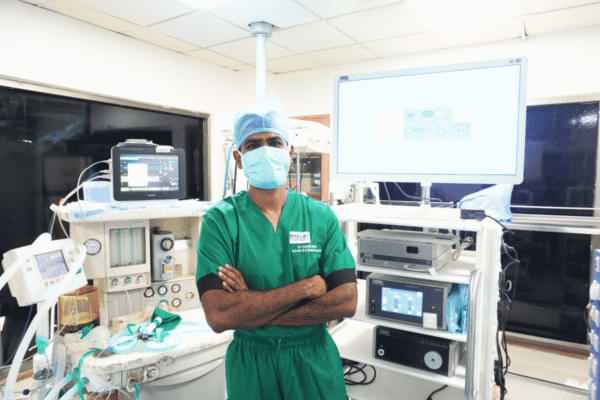
Practising as a Gastrointestinal and Laparoscopic Surgeon in Ahmedabad, with a focused interest in esophageal and upper GI surgery — including revision cases where a prior operation elsewhere did not resolve the original symptoms.

Performs laparoscopic fundoplication, Heller myotomy, hiatal hernia repair and esophagectomy across a range of case complexities.
Works alongside gastroenterologists for pre-operative manometry, pH studies and endoscopic evaluation.
Coordinates with oncology teams for esophageal cancer cases requiring combined surgical and medical treatment.
Esophagus Surgery in Ahmedabad: Frequently Asked Questions
Is esophagus surgery done through open surgery or laparoscopy?
Most esophagus surgery for achalasia, reflux disease and hiatal hernia is performed laparoscopically through small incisions. Esophagectomy for cancer is performed as minimally invasive surgery where the tumour location and the patient’s fitness allow it, and as open surgery when they do not.
How long does recovery take after esophagus surgery?
Laparoscopic fundoplication and Heller myotomy allow a return to a normal diet within 4 to 6 weeks. Esophagectomy involves a longer recovery, with diet progression supervised closely over several months.
What tests are needed before esophagus surgery?
An upper GI endoscopy is the starting point for almost every esophageal complaint. Depending on the symptom pattern, this is followed by esophageal manometry, a 24-hour pH study, a barium swallow, or a CT scan.
Will I need a feeding tube after esophagus surgery?
A feeding tube is not required after laparoscopic fundoplication or myotomy. After esophagectomy, a temporary feeding tube is placed during surgery to support nutrition while the new join between stomach and esophagus heals.
Book Esophagus Surgery in Ahmedabad
Bring any prior endoscopy, manometry or imaging reports. The first visit is about understanding the diagnosis clearly before any treatment is decided.