
Laparoscopic and open surgical treatment for gallstones, acute cholecystitis, biliary tract obstructions, bile duct strictures, and gallbladder cancer, planned around high-resolution imaging, liver function trends, and structural anatomy.
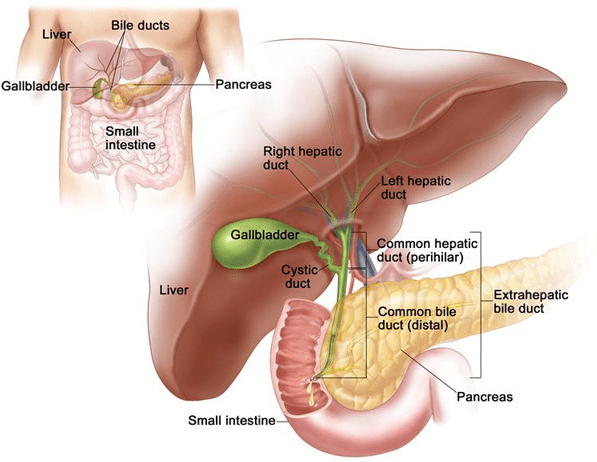
The gallbladder and bile ducts form the drainage network that transports bile from the liver into the small intestine to assist in fat digestion. When structural blocks, dense inflammation, or structural narrowing interfere with this fluid movement, it can cause severe pain, liver irritation, or infection.
Gall Bladder & Biliary Surgery Covers Multiple Pathologies
Gallstones & Cholecystitis
Hardened cholesterol or pigment deposits that form inside the gallbladder. When stones block the exit channel (cystic duct), it causes severe episodic pain (biliary colic); prolonged blockages lead to acute or chronic gallbladder inflammation (cholecystitis) and localized infections.
Biliary Obstruction & Choledocholithiasis
A condition where gallstones migrate out of the gallbladder and become trapped inside the main structural channel (the common bile duct). This blocks the continuous flow of bile from the liver, leading to obstructive jaundice, dark urine, pale stools, and potential liver cell irritation.
Cholangitis
A severe, rapid bacterial infection of the bile ducts caused by a persistent blockage. It is a clinical emergency characterized by a combination of high fever with chills, right-sided abdominal pain, and deep jaundice, requiring immediate clearing of the obstruction.
Benign Bile Duct Strictures
A physical narrowing of the bile duct lumen, usually resulting from scar tissue formation after previous abdominal surgeries, chronic inflammation, or deep biliary tract infections. It gradually restricts fluid movement and requires mechanical widening or surgical reconstruction.
Gallbladder Cancer
A malignancy originating within the mucosal lining of the gallbladder. Early stages are often discovered incidentally after routine stone removals, while advanced stages require extended surgical clearance that includes removing adjacent liver tissue and local lymph nodes.

Gall Bladder & Biliary Surgery in Ahmedabad: Procedures We Perform
Surgical choices balance minimally invasive techniques for gallbladder extraction against advanced structural reconstructions for deep common bile duct pathologies.
Laparoscopic
Cholecystectomy
for Gallstones & Cholecystitis
The surgical removal of the entire gallbladder through small abdominal incisions using a camera and specialized instruments. It is the definitive standard approach for symptomatic gallstones, polyps, and recurrent cholecystitis.
Operating through small ports reduces post-operative pain and allows a swift return to normal physical routine. If dense scar tissue or altered anatomy prevents a safe laparoscopic view, the surgeon transitions safely to an open approach to protect surrounding structures.
Duration: 1.5 - 2.5 hours
Recovery: 1 - 2 weeks
Common Bile
Duct (CBD)
Exploration
When stones migrate into the main bile duct, they must be cleared to prevent jaundice or biliary sepsis. This can be accomplished dynamically in two ways:
Laparoscopic CBD Exploration: The surgeon opens the main duct during gallbladder removal, extracts the trapped stones using specialized baskets or flushes, and closes the duct over a temporary drain.
Combined ERCP Path: An endoscope passed through the mouth clears the duct stones first via a sphincterotomy, followed by a laparoscopic gallbladder removal.
Duration: 1.5 - 2 hours
Recovery: 1 - 2 weeks
Hepaticojejunostomy
for Bile Duct
Reconstruction
A highly complex reconstruction required when a segment of the common bile duct is severely narrowed by a stricture or involved in a malignancy. The diseased segment of the bile duct is carefully excised. To restore continuous bile drainage, the healthy remaining upper bile duct is sutured directly onto a mobilized loop of the small intestine (jejunum), bypassing the lower tract entirely.
Duration: 3 to 5 hours
Recovery: 5 to 7 days
Before Biliary Surgery: What to Expect
Achieving a precise structural map of the biliary tree prevents complications and guides the selection of the correct surgical or endoscopic sequence.
1. Clinical & Laboratory Profiling
A thorough review of symptoms, checking for localized tenderness, alongside comprehensive liver function tests (LFTs) to track bilirubin levels and alkaline phosphatase markers for signs of a blockage.
2. Ultrasonography (USG)
The baseline diagnostic test used to confirm the presence of gallstones, measure gallbladder wall thickness, check for inflammation, and document the basic diameter of the common bile duct.
3. Advanced Ductal Imaging (MRCP)
A non-invasive, high-resolution MRI protocol (Magnetic Resonance Cholangiopancreatography) that provides a detailed anatomical map of the complete biliary tree, identifying the exact number and location of hidden bile duct stones or strictures.
4. Oncological Staging
For suspected mass lesions or gallbladder tumours, high-contrast chest and abdominal CT scans are utilized to check the depth of tissue involvement and confirm whether the disease affects local lymph nodes before mapping out an extended resection plan.
Recovery After Gall Bladder and Biliary Tract Surgery
The recovery trajectory transitions rapidly for simple gallbladder removals but follows a structured, monitored pathway for major common bile duct reconstructions.
Days 1–2
Following a laparoscopic cholecystectomy, patients mobilize early and start a light, low-fat liquid or soft diet within hours once nausea subsides. Most laparoscopic patients return home within 24 to 48 hours of the operation.
Week 1
Patients resume light daily household walking. Mild right shoulder or upper abdominal discomfort from the surgical gas is normal and responds well to prescribed medications. Incision sites are kept clean and dry.
Weeks 2–4
Dietary intake shifts gradually back toward a regular balanced diet. While the liver adapts to draining bile directly into the small intestine without a storage pouch, oversized or heavily fried meals should be avoided to prevent temporary bloating or loose stools. Strenuous core exercises remain restricted.
Weeks 6+
A follow-up consultation confirms stable digestion, normal liver function panels, and smooth scar healing. Patients who underwent major biliary reconstructions or hepaticojejunostomies transition back onto long-term surveillance timelines.
About Dr Sourabh Damani
Practising as a Gastrointestinal and Laparoscopic Surgeon in Ahmedabad, with a focused interest in advanced minimal access procedures, hepato-pancreato-biliary (HPB) interventions, and complex biliary reconstructions.
Performs laparoscopic cholecystectomies, laparoscopic common bile duct explorations, and open repairs for biliary tract complications.
Coordinates sequential treatment paths combining endoscopic interventions (ERCP) with minimal access surgery for complex stone diseases.
Executes radical and extended cholecystectomies for gallbladder malignancies, collaborating with medical oncology networks.
Focuses on precise pre-operative ductal anatomy mapping and structured post-operative dietary guidance to support long-term digestive health.
Gall Bladder & Biliary Surgery: Frequently Asked Question
How does the body digest food after the gallbladder is completely removed?
The gallbladder does not produce bile; it only stores it. Bile is manufactured continuously by the liver. After a cholecystectomy, bile flows directly from the liver into the small intestine in a constant, steady stream. The body adapts well to this shift, and long-term digestive function remains regular, though small, low-fat meals are recommended during the early weeks as the system adjusts.
Can gallstones be dissolved or treated with medications instead of undergoing surgery?
Medications aimed at dissolving gallstones are only rarely effective, work only on specific small cholesterol stones, and require years of continuous use. More importantly, once the medication stops, the stones almost always return. Surgery remains the only definitive solution to prevent severe clinical complications like acute infection, duct blockages, or pancreatitis.
What is the risk if a common bile duct stone is left untreated?
A stone trapped in the common bile duct creates a physical blockage that prevents bile from draining out of the liver. Left untreated, it can lead to worsening obstructive jaundice, cause a severe life-threatening bacterial infection in the blood (cholangitis), or block the adjacent pancreatic duct, triggering acute biliary pancreatitis.
Is it possible for gallstones to form again after the gallbladder has been removed?
Because the gallbladder is entirely removed during a cholecystectomy, stones cannot reform there. However, in rare instances, individuals with altered bile chemistry or structural drainage issues may develop new stones directly within the remaining bile ducts years after their original surgery. These are typically managed through endoscopic procedures like ERCP.
Book an Appointment for Gall Bladder and Biliary Tract Surgery in Ahmedabad
Please bring all recent abdominal ultrasound films, high-resolution CT or MRCP imaging reports, and recent liver function test (LFT) blood panels. The initial consultation focuses on an analytical review of these findings to determine the safest and most direct surgical path forward.