
Pancreas Surgery in Ahmedabad
Advanced surgical treatment for pancreatic cancer, chronic pancreatitis complications, severe acute pancreatitis necrosis, pseudocysts, and cystic lesions, planned around high-resolution imaging, ductal anatomy, and functional endocrine metrics.
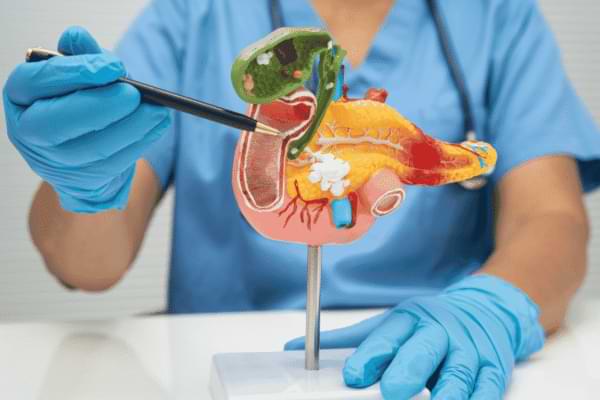
The pancreas is a dual-function gland positioned deep in the abdomen, producing essential digestive enzymes and blood-sugar regulating hormones like insulin. Because of its complex location, surrounded by major abdominal blood vessels and the bile duct system, pancreatic operations require precise anatomical dissection tailored to the specific pathology.
Pancreas Surgery Covers More Than One Condition
Pancreatic Cancer
Malignancies that most commonly develop in the head of the pancreas, often presenting with painless, progressive jaundice due to bile duct obstruction. It requires comprehensive staging with specialized CT pancreatic protocols to plan surgical removal alongside medical oncology.
Chronic Pancreatitis
Long-standing, irreversible inflammation that causes dense scarring, stone formation within the pancreatic duct, and intractable abdominal pain. Surgery is targeted at relieving ductal pressure or removing heavily damaged sections when medical therapy no longer controls the pain.
Severe Acute Pancreatitis Complications
While most acute pancreatitis cases recover with medical support, severe episodes can cause tissue death (necrosis) or severe infection. If these infected fluid collections or dead tissues do not resolve, surgical or endoscopic clearing becomes necessary.
Pancreatic Cysts & Pseudocysts
Fluid-filled sacs that develop on or inside the pancreas. These range from benign inflammatory pseudocysts (often following an attack of acute pancreatitis) to complex neoplastic cysts that carry a risk of turning cancerous and require structural removal.
Pancreas Surgery in Ahmedabad: Procedures We Perform
Pancreatic operations are highly specialized procedures dictated by the exact location of the lesion—whether it sits in the head, body, or tail of the gland.
Whipple Procedure
(Pancreaticoduodenectomy)
for Head Lesions
The standard surgical treatment for tumours or chronic inflammatory masses located in the head of the pancreas. This complex operation involves removing the head of the pancreas, the duodenum (the first part of the small intestine), a portion of the bile duct, the gallbladder, and surrounding lymph nodes.
The digestive tract is then carefully reconstructed by connecting the remaining pancreas, bile duct, and stomach directly to the small intestine. This can be performed via open surgery or an advanced minimally invasive approach based on vascular involvement and patient fitness.
Distal
Pancreatectomy
for Body & Tail Lesions
Removal of the body and tail of the pancreas, located on the left side of the abdomen near the spleen. This is performed for tumours, symptomatic cysts, or localized chronic inflammation in these specific segments.
Depending on the nature of the condition, the spleen may be removed in the same sitting (splenectomy) if the blood vessels are closely involved. This procedure is highly suited to laparoscopic access through small abdominal incisions.
Pancreatic Pseudocyst
Drainage
& Cystogastrostomy
Large, symptomatic, or infected pseudocysts that fail to shrink on their own require definitive drainage. This is frequently performed as a internal drainage procedure (Cystogastrostomy), creating a direct connection between the pseudocyst and the stomach or small intestine.
This allows the trapped pancreatic fluid to drain safely into the digestive tract internally, completely avoiding external tubes. It can be performed through advanced laparoscopic techniques or specialized endoscopic guidance.
Necrosectomy
for Severe
Acute Pancreatitis
The surgical removal of dead, infected pancreatic and surrounding fatty tissue resulting from severe acute pancreatitis. To ensure maximum safety and minimize stress on an already ill patient, a step-up approach is preferred. This starts with minimally invasive or image-guided catheter drainage, moving to a formal laparoscopic or open necrosectomy only if the infection cannot be fully cleared otherwise.
Before Pancreas Surgery: What to Expect
Given the intricate nature of pancreatic anatomy, a rigorous diagnostic and staging timeline is essential prior to scheduling any elective intervention.
1. Detailed Clinical Assessment
An evaluation of symptom patterns, back pain characteristics, recent weight loss, and an analysis of new-onset diabetes mellitus, which can be an early indicator of pancreatic dysfunction.
2. High-Resolution Pancreatic Imaging
A dedicated triple-phase CT pancreatic protocol or a high-contrast abdominal MRI/MRCP is used to map the precise relationship between the lesion and major surrounding blood vessels (superior mesenteric artery and vein).
3. Endoscopic Ultrasound (EUS) & Biopsy
An advanced endoscopic evaluation that combines ultrasound tracking from within the stomach to assess the internal structure of the pancreas, map cysts, and take highly accurate fine-needle biopsies (FNAC) if required.
4. Multidisciplinary Coordination
Oncological cases are systematically reviewed to map out the exact sequence of treatment, determining if chemotherapy or radiation should be utilized before surgery (neoadjuvant) to optimize long-term outcomes.
Meet Dr Sourabh Damani-
Pancreas Surgeon
Practising as a Gastrointestinal and Laparoscopic Surgeon in Ahmedabad, with a focused interest in hepato-pancreato-biliary (HPB) surgeries, complex pancreatic resections, and minimally invasive abdominal interventions.

Performs the Whipple procedure, laparoscopic distal pancreatectomy, and surgical internal drainage for pancreatic pseudocysts.
Manages the surgical step-up protocol for severe acute necrotizing pancreatitis and infected fluid collections.
Collaborates with medical oncology networks to construct comprehensive, multimodality treatment paths for pancreatic malignancies.
Guides patients through post-operative pancreatic enzyme optimization, dietary balancing, and long-term metabolic follow-up.
Pancreas Surgery in Ahmedabad: Frequently Asked Questions
Will I develop diabetes after undergoing pancreas surgery?
Developing diabetes depends entirely on how much of the pancreas is removed and the health of the remaining tissue. In a distal pancreatectomy or a standard Whipple procedure, the remaining portion of the pancreas is usually sufficient to produce adequate insulin. However, if the underlying pancreas is already damaged by chronic inflammation, or if a total pancreatectomy is required, regular insulin therapy will be necessary.
Why do I need to take pancreatic enzyme supplements after surgery?
When a portion of the pancreas is removed or its ductal connection is altered, the body may produce fewer digestive enzymes, a condition known as exocrine pancreatic insufficiency. Taking prescribed enzyme capsules with your meals helps break down fats and proteins properly, preventing bloating, abdominal cramps, and weight loss.
What is a pancreatic pseudocyst, and does it always require surgery?
A pseudocyst is a localized collection of fluid, tissue, and digestive enzymes that forms after an episode of acute pancreatitis. Small pseudocysts often resolve on their own with temporary observation and medical management. Intervention—either laparoscopic or endoscopic drainage—is only recommended if the cyst grows large, causes persistent pain, blocks the stomach, or becomes infected.
Can pancreatic cancer be treated without surgery?
Surgery remains the primary curative option for localized pancreatic cancer that has not invaded major un-resectable blood vessels or spread to other organs. For cases where surgery is not immediately possible, chemotherapy or radiation are utilized to control the disease or shrink the tumour, sometimes making it eligible for surgical removal later on.
Please bring all recent pancreatic protocol CT scan films, MRI/MRCP reports, EUS summaries, biopsy results, and routine blood records including recent blood sugar levels. The initial consultation centers on an in-depth review of these records to construct a safe and direct surgical plan.